
Invisible Ancestors
Meet the Huguenots

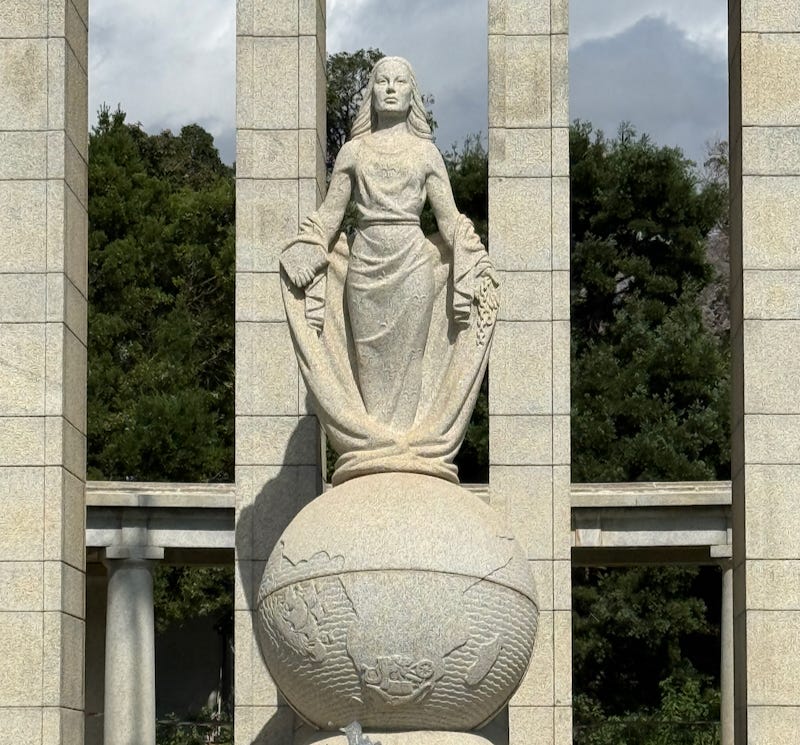
Huguenot monument, Franschhoek. Photo Lesley Lawson, March 2026.
Not so long ago I discovered the name of my mystery paternal grandmother, and through her, my Cape Dutch ancestry. Johanna Petronella Bosman (aka Joey) was a direct descendant of Hermanus Lambertus Bosman, and Joey’s mother a direct descendent of Willem Jan Klerk—both officials of the Dutch East India Company (VOC) who had arrived in the Cape in 1707 and 1793 respectively (See Ancestor Portraits).
At this time, I assumed they were my first forebears to reach South African shores, and I set about tracing their surnames through history. It was not until August 2025 that an exercise proposed by the Genealogy group on Substack challenged this thinking. We were tasked with researching the lives of 31 female ancestors and thus began a new focus on the rich history of my female ancestral lines. The Huguenot Museum in Franschhoek refers to these women who lost their surnames as “invisible ancestors”.
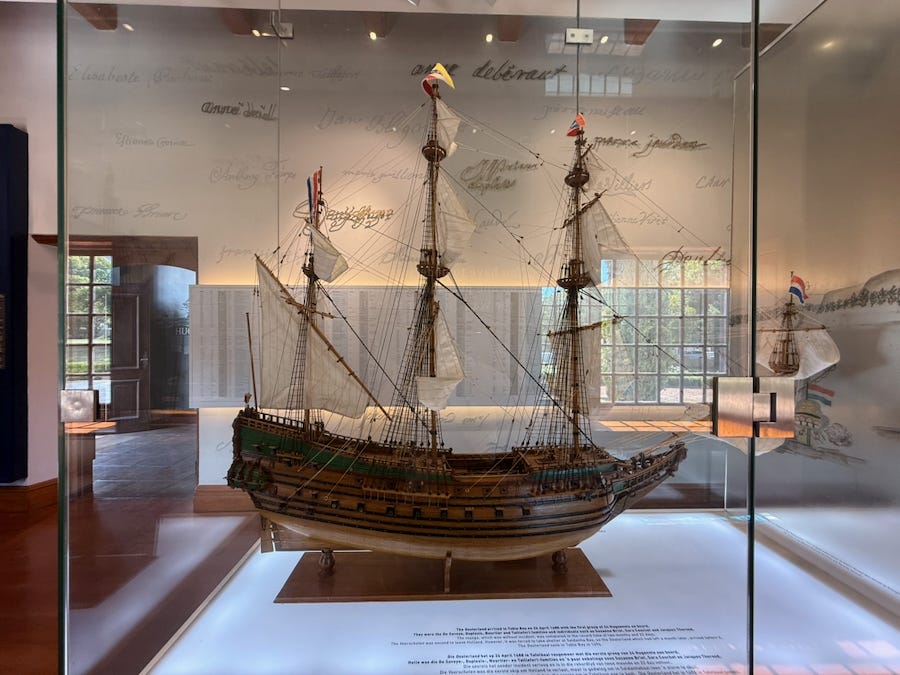
A model of the Oosterland, the first ship bearing Huguenot refugees to dock in Table Bay on 26 April, 1688. It carried the De Savoyes and 23 other Huguenot families. Huguenot Memorial Museum, Photo Lesley Lawson, March 2026.
Huguenot refugees
Many of Joey’s female ancestors were Huguenots refugees from Europe and had claim to much earlier residence in the Cape than either Bosman or Klerk.
From the 1685 the VOC attempted to recruit European farmers to expand the supply chain of the refreshment station at Table Bay, but few were willing to risk their livelihoods on an unknown continent. But as the religious persecution of Huguenots intensified, fleeing refugees began to accept the offer. A programme of subsidised emigration began: between 1688 and 1689, 175 Huguenots were settled in the Cape By 1729 it was recorded that some 279 French Huguenots and their descendants were living in the colony.
The first Huguenot ships arrived in Table Bay in April 1688. The families were settled among pioneering farmers already on land around Stellenbosch and in the Drakenstein valley, some 60 kilometres from Cape Town. Among these were Jacques de Savoye, the fourth great-grandfather of Joey Bosman on her mothers side. Though the de Savoye name has largely died out, the farm he established still thrives, and the current owners of the estate Vrede en Lust honour his history. De Savoye’s daughters, and their daughters after them married fellow Huguenots and lived on.
The settler farmers may have considered themselves to be the first inhabitants of this valley but the land had been occupied by indigenous people for over 2,000 years. Khoekhoe herders had used the valley for seasonal grazing of their vast herds until the land and water sources were blocked by settlers. Early colonial maps found by the Drakenstein Heritage Survey show the presence of the herders’ circular kraals to the north of the new farms.
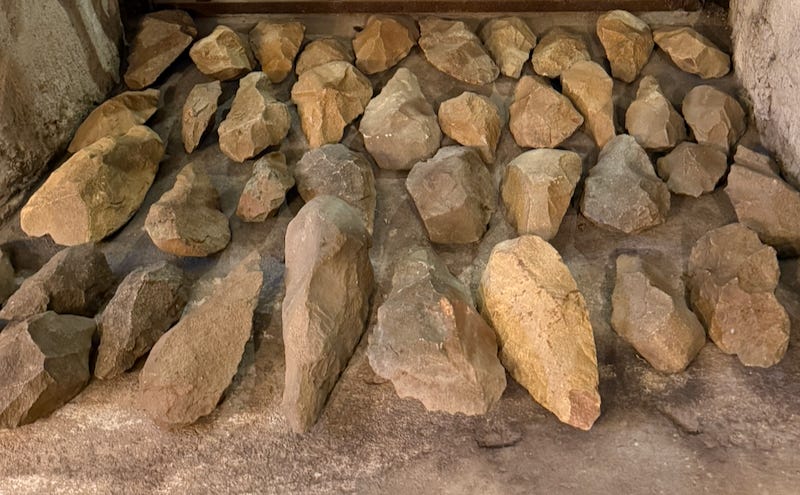
Stone age implements found in the Wellington area. Bosman Family Vineyard. Photo Lesley Lawson, March 2026.
The Gardiols
In 1689, Antoine Gardiol, Joey Bosman’s sixth great-grandfather on her father’s side, boarded the ship Wapen van Alkmaar, with his wife and three children, along with 39 other Huguenot refugees. It was a difficult journey to the Cape and the ship arrived with several dead and 104 passengers and extremely crew ill, “so weak that they could not bring out their bower anchor ...”. Antoine was one of those who had perished at sea, leaving his wife, a “sickly widow”, two daughters Susanne (21 years), Marguerite (20 years) and son Jean (15 years) to fend for themselves in an alien land.
A few months after landing at the Cape, the Gardiols joined a group of 60 Huguenots travelling inland to claim the land allotted to them by the VOC in the Drakenstein valley. The party of twelve wagons took two days to reach their destination, and on this journey, relationships began that were to last a lifetime.
The VOC had specifically recruited farmers from the wine producing regions of France for their skills in viticulture. In the same party were three brothers who had fled La Rochelle, a district in France where their family had worked in wine making for over 100 years. Abraham, (30 years), Jacques (28 years) and Pierre de Villiers (32 years) bore a letter from the governing council at Delft commending them for “a good knowledge of laying out vineyards and managing the same.”
The wagons’ first stop was at the plot of the de Villiers brothers, a joint land grant, which they named La Rochelle, after their French home. Documents accessed by historian Marq de Villiers describes their first impression of the farm: La Rochelle was untilled earth consisting mainly of rough scrub, stripped trees and trampled earth. Mounds of dung spoke of the existence of elephants in the area. They had also been warned to be on the lookout for leopards, which were numerous.
Having dropped the de Villiers brothers with their meagre household goods, the wagons moved on to the Gardiol’s plot. It seems that the Gardiol’s land grant was awarded to the male in the family even though Jean was only 15 years old. They named their farm La Cotte.
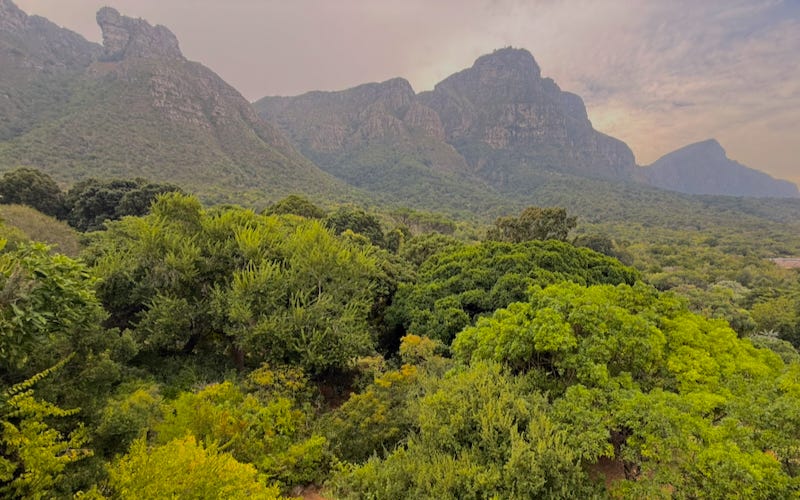
Western Cape landscape. Photo Lesley Lawson, March 2026.
Insular community
The refugees’ plots were dispersed among the more established Dutch and German farmers in the district. There was some dissatisfaction around this, and the Huguenots requested that they be resettled closer together. They also requested to start a French school for their children, but the VOC refused. It was clear that the authorities wished this insular community to integrate. They were, however, allowed their own French minister and church, though when Rev. Pierre Simond left the colony in 1700, he was not replaced.
Writing about the community, historian Karel Schoeman notes: “Of Dutch and German farmers in the area, a number had coloured wives who were former slaves. Baptism, church membership and free status were more important than colour at this time.”
Gardiol m de Villiers
The two younger de Villiers brothers lost no time in cementing their relationship with the Gardiol sisters. As soon as they were granted their own separate plots, the brothers married. Abraham and Susanne Gardiol were settled at Champagne farm, adjacent to the original plot. Margurite and Jacques married a year later, living on the original plot renamed La Bri. Pierre de Villiers married Elizabeth Taillefert, daughter of one of the original Huguenot settlers and were neighbours at Bourgogne.
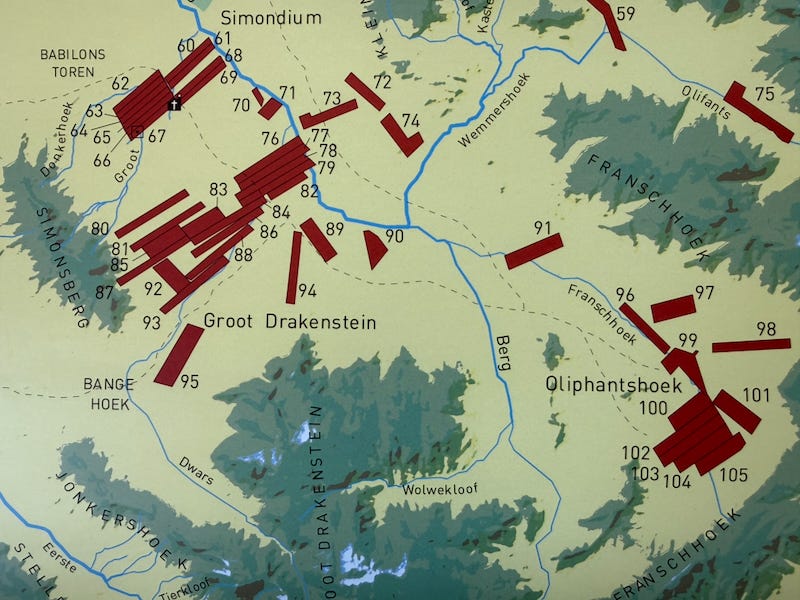
Map of first land grants to Huguenots showing La Cotte (98), Champagne (100), La Bri (102) and Bourgogne (103). Within ten years Abraham de Villiers had also bought the farms Meerlust (76) and Eensaamheid (77). Huguenot Memorial Museum.
Soon the Drakenstein district became a de Villiers’ fiefdom: Jacques and Pierre were successful farmers in the district, and Abraham became a councillor in local government and community leader.
By 1707 Abraham and Susanne de Villiers had six living children and were established and prosperous. Over the years Abraham purchased another five farms—including, briefly the now-famous Boschendal—and became the largest landowner in the district. According to taxation records, between 1692 and 1719 Abraham’s vines had multiplied from 6,000 to 25,000.
Western Cape vineyard. Photo Jacqui Nolte, 2026.
Ancestral mathematics
Tracing our female ancestry reveals the true test of genealogical research. When we include these invisible women, there is such a myriad of forebears, to single out any one seems a random exercise. Going back nine generations each one of us has:
4 grandparents
8 great-grandparents
16 second great-grandparents
32 third great-grandparents
64 fourth great-grandparents
128 fifth great-grandparents
256 sixth great-grandparents
512 seventh great-grandparents
1,024 eighth great-grandparents
2,048 ninth great-grandparents
Like many other white South Africans, my grandmother’s female lines are strung with invisible Huguenot women who live on in the memory of the notable Western Cape wine estates today.
Thank you for reading. The version on my website includes references. You can subscribe for free by clicking the button below.
This is wonderful Lesley.
Thanks for this wonderful piece, Lesley, there are so many invisible women. My grandmother on my Mom's side was a Huguenot, Conje. I go to Franschhoek every year for the book festival and run a literacy quiz for the 4 farm schools. I am a great supporter of finding hidden women in history, as a history teacher and was part of Asinakhuthula, a project to research hidden women in history. Your piece is so important.