
Rough Crossing
Hermanus Bosman's journey

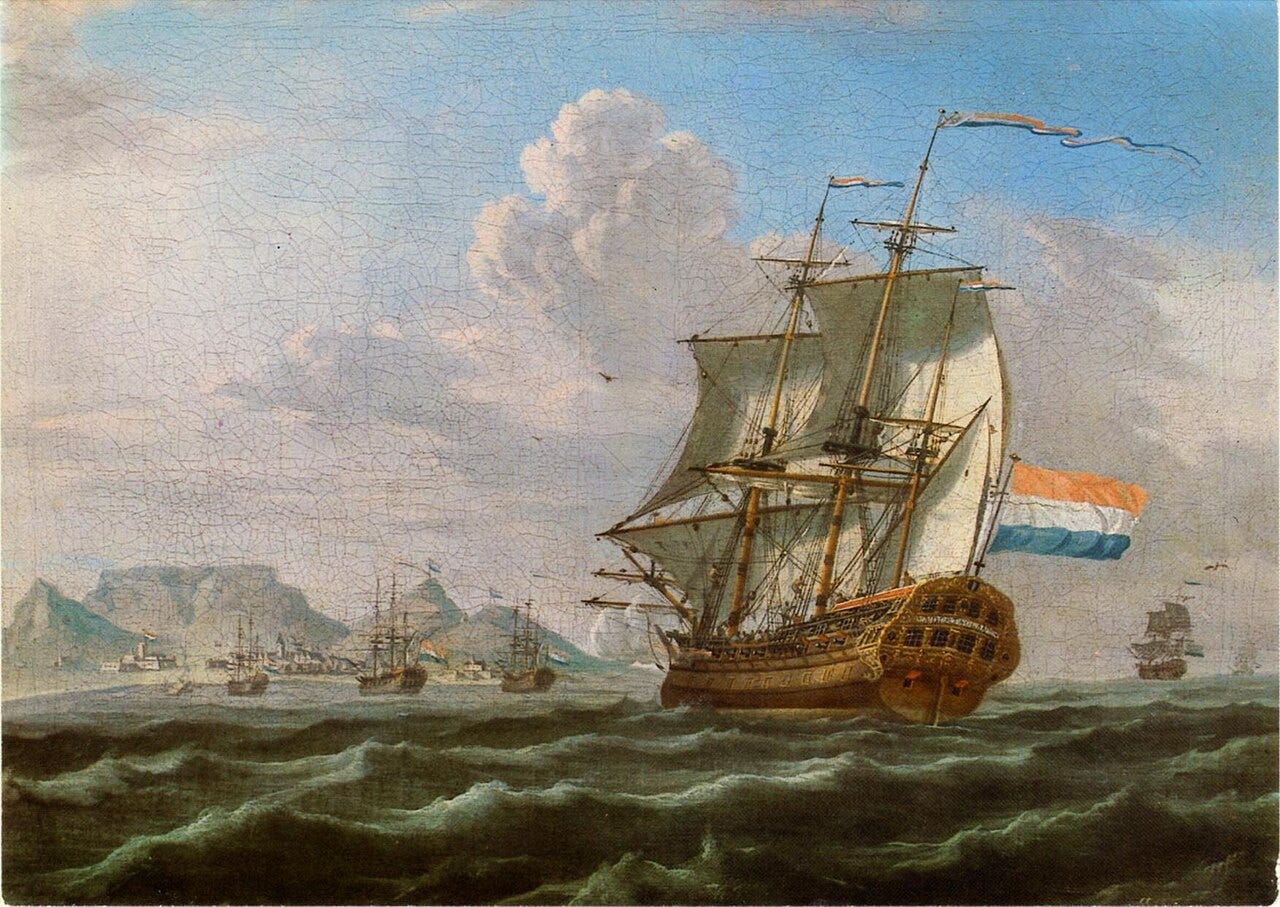
Dutch East India Company (VOC) ship in Table Bay, 1769. Public Domain via Wikimedia Commons.
My paternal grandmother Joey was a direct descendent of Hermanus Bosman (1682-1769), progenitor of the South African Bosman family. But the 1707 arrival of my seventh great-grandfather in the Cape colony happened through misadventure rather than intent.
Humble origins
Hermanus Bosman’s father was a German immigrant to Amsterdam who found work as a baker and married a local girl. Hermanus, the eldest of four children, was born seven months after the wedding.
In this period the Dutch East India Company or Vereenigde Oostindische Compagnie, (VOC), with its headquarters in the city, was the single most powerful corporation on earth. The world’s first multinational, the VOC monopolised trade with East in spices, tea, coffee, silk, cotton and porcelain. It also had the power to maintain armies, make treaties and wage war.
As the major employer in Amsterdam, it was logical that the young Hermanus would look to the VOC for work. At the age of 23 years, he signed a ten-year contract to sail between the Netherlands and Batavia (Indonesia). His role was that of a sick-comforter—a cross between a lay preacher and social worker—employed to tend to the spiritual needs of the crew. The salary (and status) of the job was low, but more than double the pay of the VOC soldiers on board.
Rough passage
In 1706 Hermanus found himself on the ship Huis Overrijp bound for Batavia. Nothing in his young life could have prepared him for this journey.
VOC merchant ships, or East Indiamen as they were known, were built for commerce not comfort. They resembled floating factories accommodating up to 350 men in dark, damp, vermin-infested decks.
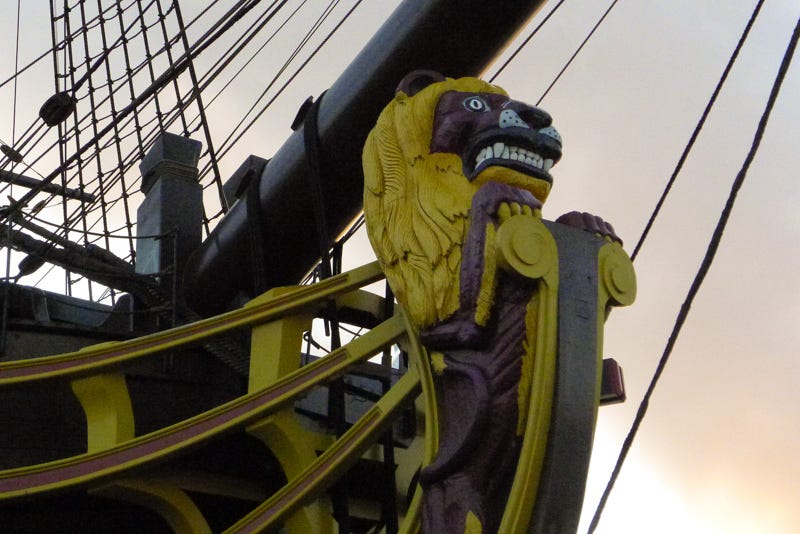
Masthead, replica East Indiaman, National Maritime History Museum, Amsterdam. Photo Lesley Lawson, 2012.
Low wages and poor working conditions attracted employees of dubious quality. One early VOC official, J. de Grevenbroek wrote, “It is fairly agreed by the common consent of all seafaring men, that any murderer who signs on for the voyage to India under the savage villainy of these men has received more than his due of punishment.” He added, “a sailor could terrify the soldiers on board with the statement “Now the Devil rules, there is no God anymore.”.
Among the crew there were constant fights with fists and knives over food and alcohol. Discipline was harsh and misconduct severely punished. Sailors were whipped for misdemeanours and for worse offences, men were chained in irons and imprisoned below deck. Those committing mutiny or murder were sent to the gallows. Maritime historian Marcus Rediker summarised the deep-sea ship as “one of the most violent work environments of the early modern world.”
Bosman’s job involved preaching to this violent mob as well as praying with the sick and comforting those to be executed. VOC ship surgeon Johan Merklein wrote in his diary that the sick comforter was constantly moving between “The sickbed, the whipping post, and the gallows.”
Bosman arrives in the Cape
On Bosman’s first return journey, the ship stopped at the company’s supply station at the Cape of Good Hope. By now it had grown into a small settlement, providing fresh food and supplies so vital to maintain the Dutch trade route to the East. While anchored in Table Bay, Bosman sent word to the Cape VOC officials, asking permission to be put ashore “on account of the extremely rough life on board ship”.
His request for a post as sick comforter in the colony was granted, and he was sent inland to a farming community in the Drakenstein district that had been without a minister for several years. He initially boarded at one of the French Huguenot farms, but herein lies another tail.
Rewriting rewritten history
Since beginning this research, I have noticed a subtle process of rewriting history on sensitive topics to do with colonialism and slavery.
In 2012 I visited the replica 18th century VOC ship that was moored outside the National Maritime History Museum in Amsterdam. At that time, the museum’s official website told much of the glorious Dutch past and the exotic spices carried by such ships. The sailors were praised for their courage and endurance and the navigators extolled for their skill in charting their routes across wild and unpredictable seas. Though attention was devoted to the hardships of the crew—their cramped living quarters and simple diet—of violence, floggings and execution there was not a mention.
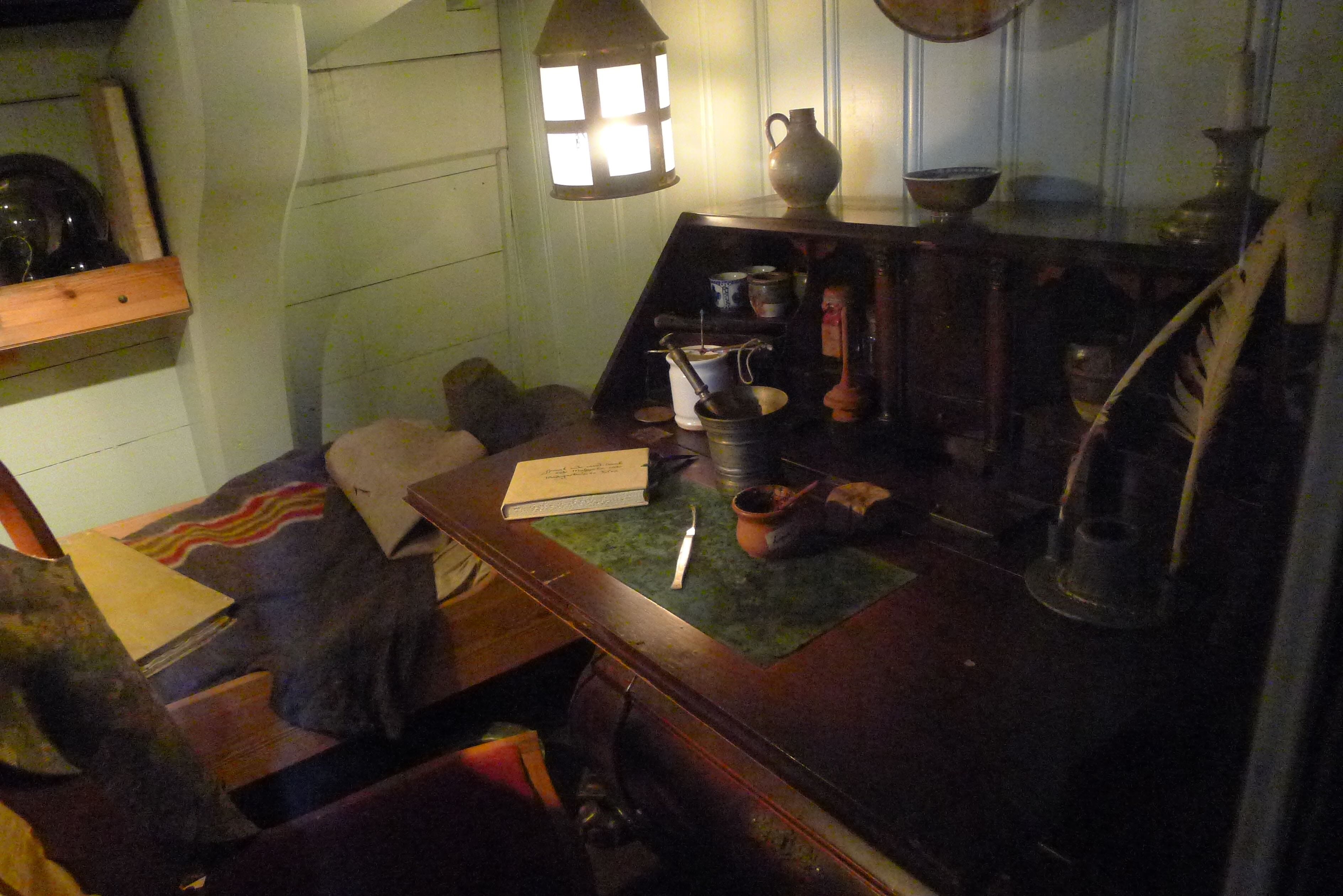
Captain’s cabin, replica East Indiaman, National Maritime History Museum, Amsterdam. Photo Lesley Lawson, 2012.
Built as a tourist attraction, the replica was described as “a spectacular location for events, parties and receptions”, an adventure playground for kids. Indeed, on the day of my visit there were many tourists snapping and children clambering over the decks. They could not have been aware of the realities of life on the East Indiamen, or of the hidden cargo in the hold of these merchant ships—slaves.
In the post “black-lives-matter” world, this is beginning to change. Today the official website of the museum makes explicit reference to slavery and the Dutch colonial past.
It concedes that, from the early 1990s, the replica has been criticised by a vocal public as a “floating provocation” and a “glorification of robbery, oppression and slave trade”. Proposals were even made to sink the ship. However, neither the municipality nor the museum agreed, and “for a long time, the museum told no stories on the ship about violence or slavery committed by the East India Company”.
The National Maritime Museum has now made a commitment to a more truthful account and has already begun to change the narrative on the ship and in the museum itself, to highlight inequities cause by colonial trade.
I look forward to a return visit.
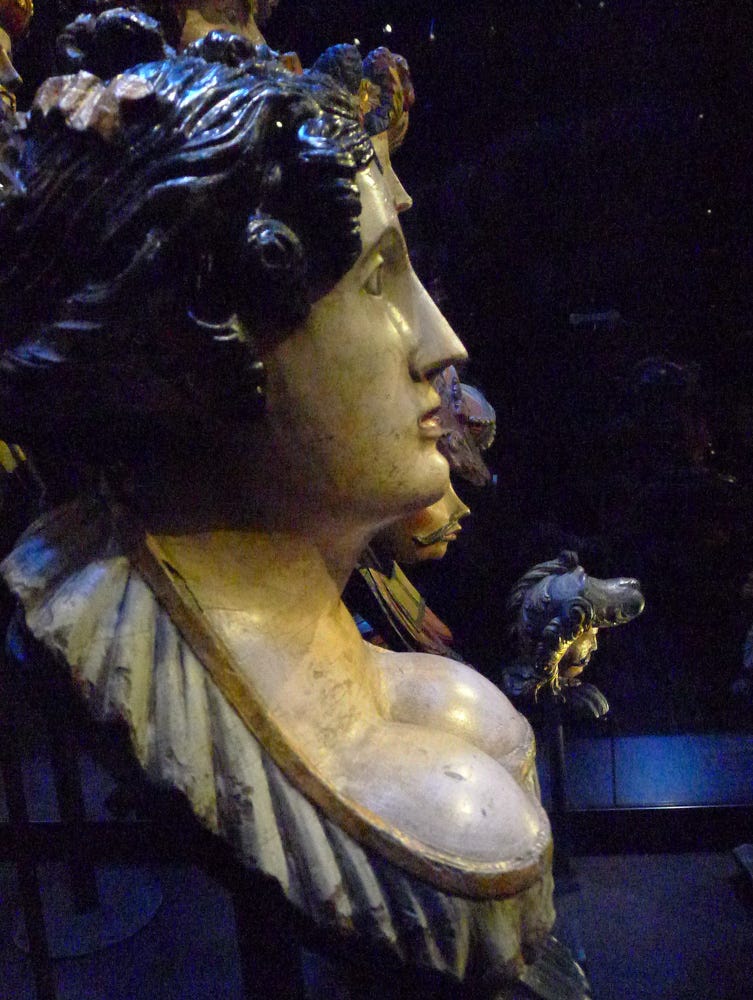
East Indiaman masthead, National Maritime History Museum, Amsterdam. Photo Lesley Lawson, 2012.
Thank you for reading. You can find the references in the version of this story on my website.
If you enjoyed this please subscribe by pressing the button below and please pass on to anyone else who may be interested.